Thu 16 Jul: Geelong v St Kilda (GMHBA, 7:30pm) · Fri 17 Jul: Sydney v Adelaide (SCG, 7:40pm)
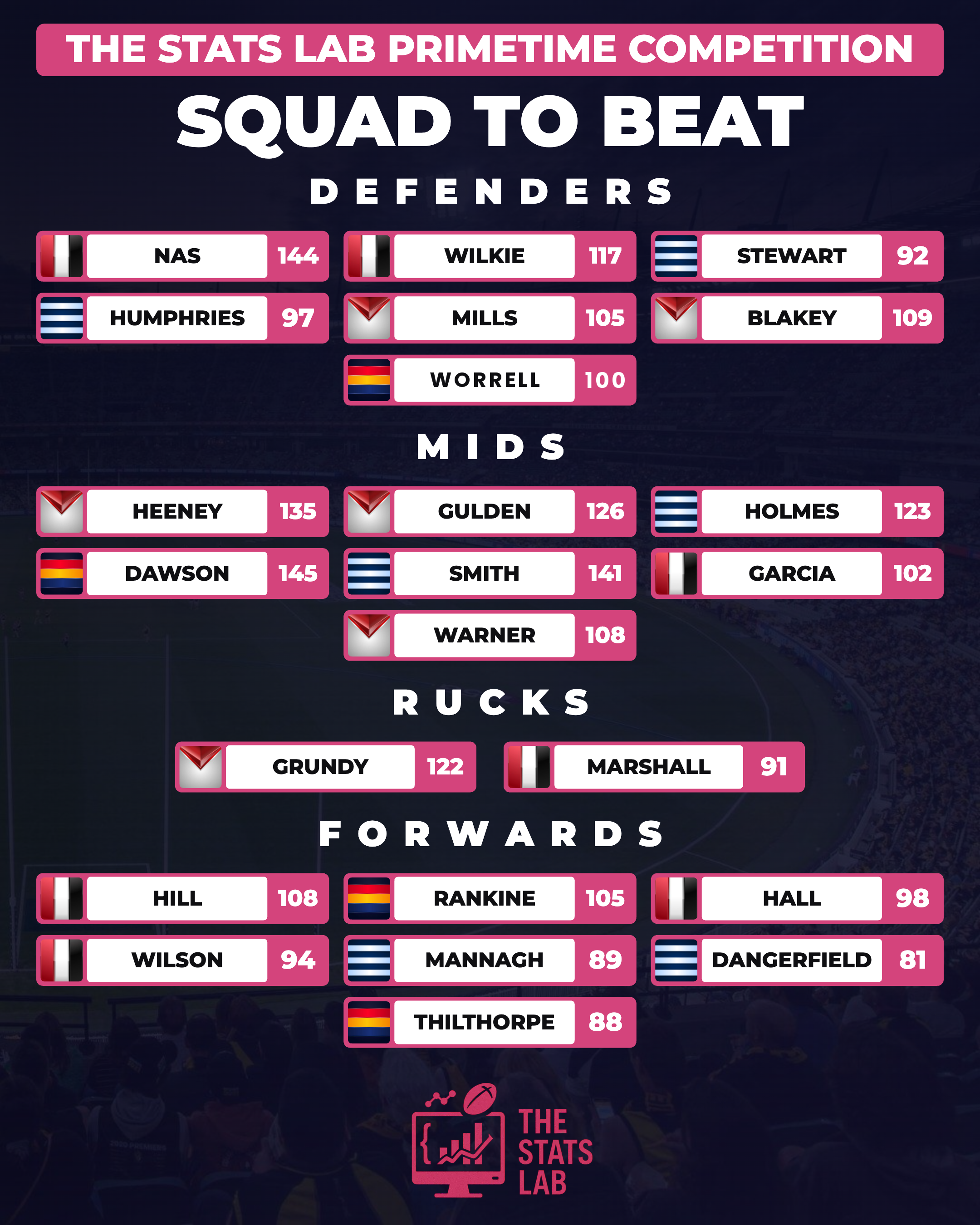
Quick word on every call, position by position.
Defenders
Wanganeen-Milera — Tagged by Oisin Mullin, and the tag is the story here. Geelong rank 8th for defender concede at +1.8%, with handballs at +11.3% (2nd) and tackles at +10.1% (2nd) genuine positives for NWM's contested game, and marks at -8.3% (14th) the notable negative. Mullin's tag penalty brings his prediction down meaningfully from his 137 average.
Wilkie — Shares the Cats matchup with NWM, same 8th-ranked defender concede at +1.8%, handballs +11.3% (2nd) and tackles +10.1% (2nd). Wilkie's disposal-and-tackle game suits those stats directly. No tag concern.
Stewart — St Kilda rank 4th for defender concede at +5.1%, with kicks at +7.4% (4th) and marks at +11.9% (5th) the headline positives for Stewart's intercept-marking style. Back from concussion, this is his first game in several weeks.
Humphries — Shares the Saints matchup with Stewart, same kicks +7.4% (4th) and marks +11.9% (5th). A genuine positive matchup for Humphries's disposal-heavy game. Tackles at -13.3% (16th) is the one notable negative.
Blakey — Adelaide rank 11th for defender concede at -2.6% overall, a mild negative. The standout positive is goals at +41.6% (2nd), the Crows allowing goals to opposition defenders at an exceptional rate, along with tackles at +7.2% (5th). Kicks at -2.8% (12th) and marks at -6.7% (12th) are the negatives for Blakey's disposal game.
Worrell — Sydney rank 14th for defender concede at -4.2%, a genuine negative overall. Marks at -14.2% (16th) is the most damaging stat, though tackles at +7.3% (4th) and goals at +12.0% (4th) are genuine positives. The matchup works against his game but there's a correlation angle worth noting. With Rory Laird sidelined, Worrell averages 114.0 across two games compared to 99.9 in the 14 games they've played together, a +14.1 boost. Small sample but directionally meaningful for a player who gets more of the ball when his captain isn't around to absorb it.
Mills — Adelaide rank 12th for defender concede at -2.6%, with kicks at -3.0% (13th), handballs at -8.3% (16th) and marks at -5.4% (10th) all mild negatives. The positives are tackles at +5.5% (7th) and goals at +34.1% (2nd), the Crows one of the most generous teams in the competition for opposition defender goals. Mills's output comes through disposal and CBA time rather than goals, so the matchup isn't as clean as the Geelong v Saints draws.
Defender summary: NWM's tag could be cause for a fade. With the Mullin penalty applied, his output from his 137 average takes a meaningful hit. If you're fading him, the depth dries up quickly outside the top eight or so. The Geelong v Saints matchup is clearly the preferred source, with the Saints ranked 4th for defender concede at +5.1%, kicks +7.4% (4th) and marks +11.9% (5th), which opens the door for a Connor O'Sullivan type to post a big number if you're willing to take a punt. Beyond the top group, Jai Serong is the other logical option from Sydney, though the Crows draw is considerably less appealing, with Adelaide ranked 11th at -2.6%. The Geelong v Saints matchup is far more attractive than Sydney v Adelaide for defender selection this week.
Midfielders
Bailey Smith — St Kilda rank 15th for midfielder concede at -3.0%, with kicks at -6.0% (17th) the main negative for Smith's kick-heavy game. Goals at +5.0% (8th) is the one genuine positive. The model backs his volume and CBA access to overcome the matchup, and at 143 average he's the highest-ceiling midfielder in the primetime pool.
Heeney — Adelaide rank 8th for midfielder concede at -0.3%, effectively neutral. Kicks at +2.9% (6th), handballs at +4.4% (4th) and tackles at +5.0% (7th) are genuine positives. The Crows are a workable draw for Heeney's all-around accumulation game.
Gulden — Shares the Crows matchup with Heeney, same kicks and handballs positives apply. Goals at -35.5% (17th) is the notable negative but Gulden's game doesn't rely on goal scoring. His tackles and disposal accumulation drive his output.
Dawson — Tagged by James Jordon, which brings Dawson down -13.2% from his 139 average, a significant discount. Sydney rank 14th for midfielder concede at -2.0%, with kicks at +2.6% (7th) and handballs at +3.0% (5th) mild positives, marks at -12.9% (16th) the negative. He's the second tag in the primetime pool and the discount is steep.
Holmes — Shares the Saints matchup with Bailey Smith, same 15th-ranked midfielder concede at -3.0%. Marks at +2.1% (8th) and goals at +5.0% (8th) are mild positives within that. Holmes's running game generates through volume regardless of matchup.
Garcia — Geelong rank 10th for midfielder concede at -0.4%, effectively neutral. Tackles at +7.9% (5th) is the genuine positive for Garcia's contested game. Handballs at -3.0% (13th) and goals at -19.0% (14th) are the negatives. A neutral-to-mild draw but Garcia generates through CBA access and contested possession regardless.
Warner — Shares the Crows matchup with Heeney, Gulden and Mills, same kicks, handballs and tackles positives. Warner's contest-heavy game suits the tackles positive at +5.0% (7th). Selected on consistent output in a broadly neutral draw.
Midfielder summary: Lots of premium averaging midfielders in here who you simply can't skip. Gulden or Heeney may attract attention from Peatling in Sydney's midfield, while Dawson likely cops Jordon, who's been doing more work through the middle than his nominal forward role suggests, particularly with Rowbottom's adjusted role pushing further forward. Even with those tags in play, both Heeney and Dawson remain ahead of most of the available pool. Quite a few of these guys rank highly across the full open player pool, not just within the primetime window. Garcia's continuity in CBA numbers in recent weeks makes him a sleeper pick that many will skip, worth keeping an eye on.
Rucks
Marshall — Geelong rank 5th for ruck concede at +12.8%, with kicks at +12.9% (3rd), handballs at +10.6% (4th) and tackles at +13.0% (5th). Marshall's physical ruck contest style suits the tackles positive directly. A strong ruck matchup.
Grundy — Adelaide rank 8th for ruck concede at +0.3%, effectively neutral. Kicks at +8.9% (5th) and handballs at +7.9% (5th) are genuine positives. Marks at -13.4% (13th) and tackles at -10.0% (13th) are the negatives. Grundy's disposal-focused ruck game suits the kicks and handballs positives.
Ruck summary: Hard not to pick both of these. Marshall and Grundy are actually ranked 1 and 2 in the open ruck pool for the round, not just within primetime. Marshall as the undisputed solo ruck is back to his old scoring ways, which only raises the question of why TDK was brought in to begin with (as an annoyed fantasy player). Both slot in comfortably.
Forwards
Hill — Geelong rank 9th for forward concede at +1.2%, broadly neutral. Kicks at +2.2% (7th) and marks at +3.1% (9th) are mild positives. Worth noting that Hill has been playing primarily as a defender in recent weeks, and that's actually a better matchup, with Geelong ranking 8th for defender concede at +3.4%, handballs at +13.6% (2nd) and tackles at +10.4% (2nd). If he spends the majority of his time back, the matchup data works more in his favour.
Rankine — Sydney rank 15th for forward concede at -5.3%, a genuine headwind. Kicks at -1.3% (10th) and marks at -11.4% (15th). Through the midfield the Swans are 14th at -2.0%, also negative when Rankine rotates. Selected on season average depth, this is a tough week for Rankine.
Hall — Shares the Cats forward matchup with Bradley Hill, same 9th-ranked concede at +1.2%, kicks +2.2% (7th) and marks +3.1% (9th).
Wilson — Geelong rank 9th for forward concede at +1.2%, broadly neutral. Kicks at +2.2% (7th) and marks at +3.1% (9th) are mild positives. A slightly better matchup as a forward than the midfielder draw suggests, and a more natural reflection of how Wilson actually plays.
Mannagh — St Kilda rank 13th for forward concede at -3.1%, with kicks at -2.1% (11th) and marks at -1.6% (11th). A mild headwind across the board. Mannagh's four-goal effort in R18 showed his ceiling but the Saints matchup won't help him replicate it. Selected on recent form over matchup.
Dangerfield — Shares the Saints forward matchup with Mannagh, same 13th-ranked concede at -3.1%. Dangerfield's hybrid midfielder-forward role means he generates through CBA access and contested possession regardless of the forward matchup. The St Kilda draw is a mild headwind on paper but his output comes from a different source.
Thilthorpe — Shares the Swans forward matchup with Rankine, the same 15th-ranked concede at -5.3%, and marks at -11.4% (15th) is the most damaging stat for Thilthorpe's ruck-forward marking game. Selected on raw output in a matchup that works against his style.
Forward summary: Difficult matchups across the board for all primetime teams, which gives very limited matchup advantage in the forward line. This essentially forces a template selection on player averages rather than exploiting a particular draw. Within that, Miers (returning to AFL after time in the VFL) and Rachele (being used predominantly as a forward rather than his more natural role) become potential fades from the top end of the pool. Dangerfield is an interesting play given the ceiling he's still clearly capable of, but the question is whether a genuine forward role opens up for him with Cameron missing. If it does, his scoring upside is significant.